Advisor practice operations · Original IAM analysis
When a Retirement Second Opinion Disagrees: Explain the Review Before Promising an Answer
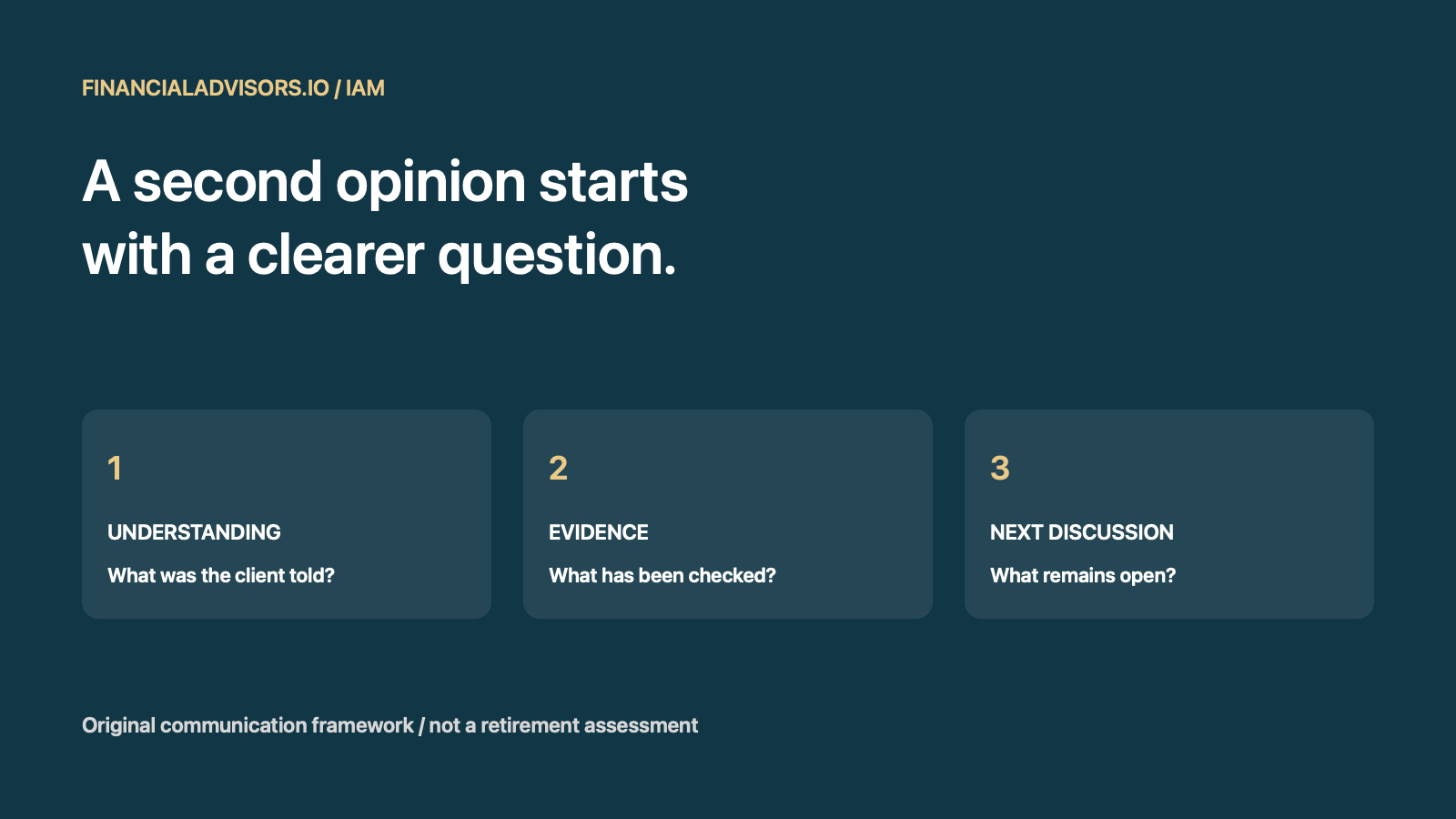
A retirement conversation can become difficult before anyone opens a planning model. A new client remembers being told that a proposed lifestyle was affordable. The current practice sees unanswered questions. If the first response is an argument about the previous professional, the client may hear a contest over credibility rather than an explanation of the work still required. A better public description of the service tells people how the practice investigates a disagreement, explains uncertainty and records the next step.
This is original IAM analysis of a practice’s communication process. It does not assess a household, calculate a sustainable withdrawal rate or recommend a retirement decision. The examples below are fictional editorial exercises for an advisory business reviewing its website and meeting materials.
The source conversation: a disagreement deserves investigation
In the November 12, 2026 203rd Kitces & Carl discussion, Michael Kitces and Carl Richards consider a client whose retirement expectations differ from a new advisor’s assessment. Their discussion emphasizes exploring the current evidence without attacking the previous advisor, explaining possible adjustments and involving the client in the conversation. Read or listen to their full treatment for their professional perspective; this article develops a separate publishing and service-design exercise.
The episode gives a practice a useful question for its own materials: does the website explain how a second opinion is formed, or merely promise a more reassuring answer? A claim that the firm will always find a better plan creates expectations that an actual review may not support. The alternative is to describe an understandable investigation whose outcome remains open.
Describe the service before promising an answer
A page offering retirement reviews should make the service tangible. Explain who conducts the initial discussion, what the agreed review covers, what the client receives and how questions are resolved. A reader should be able to distinguish an introductory conversation from a completed analysis. If a fee, engagement or separate professional is needed for the next stage, the practice should explain that through its own approved process.
The US SEC’s Investor.gov explanation of financial planners notes that services and compensation arrangements vary and encourages people to understand a professional’s scope, costs and background. That is a US educational source, not a statement of Canadian registration requirements. For a Canadian practice, the editorial lesson is to describe the actual service and jurisdiction clearly rather than importing an American credential or rule into a local promise.
Make room for the client’s earlier understanding
Consider a fictional website enquiry: “I was told I could retire next year, but now I am worried.” A useful response acknowledges the question without diagnosing the plan through a contact form. The team can explain how a review starts and how the client can share relevant information through an appropriate channel. It should avoid announcing that the earlier advice was wrong before the underlying assumptions and scope have been examined.
For an internal communication exercise, give the writer two columns. The first contains what the client says they understood. The second contains what the practice has actually verified. A remembered reassurance belongs in the first column until its meaning and context are established. This distinction can keep a draft from converting a client’s recollection into a factual allegation about another professional. It also leaves space for a misunderstanding, an outdated input or a genuinely different assessment.
Keep an assumptions record that a colleague can follow
An explanation becomes easier to review when its assumptions have names. A practice can use a source record that identifies the date of the information, its origin, the question it supports and any unresolved discrepancy. This is a proposed communication aid, not a financial-planning methodology or a substitute for the firm’s required records. The qualified professional determines which inputs and analysis the engagement needs.
Imagine two drafts of a meeting summary. One says, “Your previous plan used the wrong expenses.” The other says, “The spending figure in the material supplied differs from the figure discussed today; the review will reconcile that difference before drawing a conclusion.” The second sentence identifies work that remains. It avoids pretending that the writer has already established why the numbers differ. A reviewer can then check whether the promised reconciliation actually happened.
Separate the question, the model and the decision
A client’s question may concern confidence, family responsibilities, employment or the meaning of retirement. A model addresses a defined set of inputs and assumptions. A decision involves the client and the appropriately qualified professional within the agreed engagement. Public content should not collapse those three things into a single score or a reassuring slogan. Explaining the distinction helps a prospective client understand why a useful review may require more than a quick calculation.
A meeting handout could therefore have three clearly labelled spaces: what the client wants to understand, what the analysis examines and what remains to be decided. This article proposes the structure without supplying personal answers. When a draft contains a conclusion, the reviewer should ask which analysis supports it and whether the wording carries the limitations of that analysis. A diagram can clarify the sequence without implying that every client should choose the same outcome.
Write uncertainty in language that survives a short excerpt
A long article can carefully qualify a statement that a social card accidentally turns into a guarantee. Review the headline, image caption and introductory email together. If the full explanation says a result depends on information still being checked, the short version should retain that condition. A sentence such as “See how our review works” makes a different promise from “Find out why your retirement is secure.” Only publish claims the practice can support.
A useful editing exercise is to remove the surrounding paragraph and read the sentence alone. Does “we will explain the scenarios considered” become “we will make retirement work” when shortened? Does a hypothetical example appear to be a real client result? Does the phrase “independent review” describe the actual business relationship? These are questions for the practice to resolve with its own reviewers before publication, rather than claims that this article has certified its materials.
Use examples to explain the process, not prescribe a choice
A fictional example can show how a conversation is organized without recommending an action. For instance, one sample agenda might begin with the household’s question, move to information that needs checking and end with a record of follow-up responsibilities. It can demonstrate how an advisor explains a disagreement while leaving the particular assumptions, calculations and decisions outside the public example. Label the example wherever it appears, including any image or downloadable worksheet.
Do not add an invented account balance, withdrawal rate or projected return merely to make the story feel concrete. Those numbers can distract from the communication task and create the appearance of an assessment. If a practice wants a quantitative illustration, it needs its own appropriate methodology, assumptions and review. A general business article cannot turn a plausible-looking chart into evidence that a particular retirement plan is suitable.
Give the follow-up a visible owner
A difficult conversation may end with several open questions. A clear service description explains how the practice closes them. A proposed meeting record can identify the question, the information needed, the person responsible and the agreed route for the next discussion. It should not imply that an unanswered question has been settled because a polished summary was sent. The client needs to understand which part of the review is complete and which part remains open.
For the firm’s editorial team, this creates a practical distinction between an acknowledgement and a substantive answer. An automated reply can confirm receipt of an enquiry. It cannot establish that an advisor has reviewed the client’s circumstances. Website copy, confirmation messages and staff scripts should describe the stage honestly. Avoid publishing a response-time promise until the business has agreed who can meet it and what that response actually includes.
Handle a disagreement without making the previous professional the story
A second-opinion page can attract readers who feel let down. That does not make criticism of a former advisor the most useful organizing idea. An article can explain how the current practice checks information, discusses differences and documents its own work. It should distinguish a difference in assumptions from a claim of misconduct. Where a real complaint arises, the firm should use the appropriate professional and jurisdiction-specific process rather than turning a public marketing page into an adjudication.
An editor can test the tone by asking whether the draft remains useful if every reference to the earlier advisor is removed. If nothing remains except an assertion that the new firm is better, the article needs a clearer account of its service. Explain what the reader can expect to happen, what information will be examined and how a question can be raised. That gives the practice something concrete to stand behind without claiming an outcome in advance.
Make the enquiry route match the sensitivity of the question
A public publishing contact is a place to ask about this article or the platform. It is not a route for sending account statements, identity documents or private household records to IAM. An advisory practice describing its own service should tell prospective clients how to begin safely through the firm’s approved channels. The information requested at first contact should match what the business is prepared to handle at that stage.
Review the actual mobile journey, including the button label, form instructions and confirmation message. A reader should not have to guess whether they are booking a general introduction, requesting a paid analysis or submitting documents for a review already underway. These distinctions affect expectations even when the page contains no financial recommendation. If a route is not available, publish an accurate alternative rather than leaving a button that suggests the service is already operating.
Build a reusable review exercise for the practice
Choose one retirement-review page and one meeting-summary template. Ask a colleague who did not write them to identify the service offered, its limits, the next step and the owner of an unresolved question. Then compare those answers with what the practice actually intends to provide. The exercise can reveal an ambiguous promise without requiring a fabricated client case or a dramatic claim about retirement outcomes.
Retain the reviewed wording and the date it was approved through the firm’s process. If the service changes, update the connected pages and templates together. If an error is discovered, explain the correction where appropriate rather than silently making an older message appear to have said something different. No improvement in conversion, trust or financial results is claimed here; those outcomes would need separate evidence.
Keep source credit distinct from an endorsement
Linking a professional discussion does not mean its authors reviewed this article, endorse the practice or participated in its service. A source box should identify the episode as the starting point for the topic and label the publisher’s own analysis separately. Likewise, a link to Investor.gov provides access to a US educational explanation; it does not give a Canadian firm a regulatory approval badge. Check the final page for logos, captions or button wording that might accidentally imply either relationship. This is especially useful when the same material is repurposed as a presentation or social graphic, where the original explanatory paragraph may disappear.
A clearer promise is a process the business can explain
The most useful communication promise may be modest and specific: the practice will explain what it reviewed, identify the limits of its analysis and make the next discussion understandable. Whether a person can retire on a particular timetable is a different question requiring an appropriate individual engagement. A public article can help a business describe that boundary without giving the reader a premature answer.
For a publishing team, the next action is concrete. Review one claim on the retirement page, attach the evidence that supports it and check that the contact journey delivers the service described. Keep the professional’s assessment separate from the marketing team’s explanation. That produces material a reader can understand and a colleague can review, while leaving personal financial decisions with the appropriate qualified professional.
Sources and editorial scope
Kitces & Carl episode 203 — Helping Clients Who Want A Retirement They Can’t Afford (November 12, 2026), checked November 12, 2026.
Original IAM publishing and service-communication analysis, separate from the linked professional discussion. Examples are fictional. No personal retirement assessment, investment recommendation, regulatory certification or endorsement is provided; US educational material is identified as such.