Canadian advisor communications · Original IAM analysis
After the October 28 Rate Increase: A Clearer Client Message
Post-decision analysis · Published . Official Canadian source facts below are separated from original IAM business-communication analysis.
Verified decision: a 25-basis-point increase
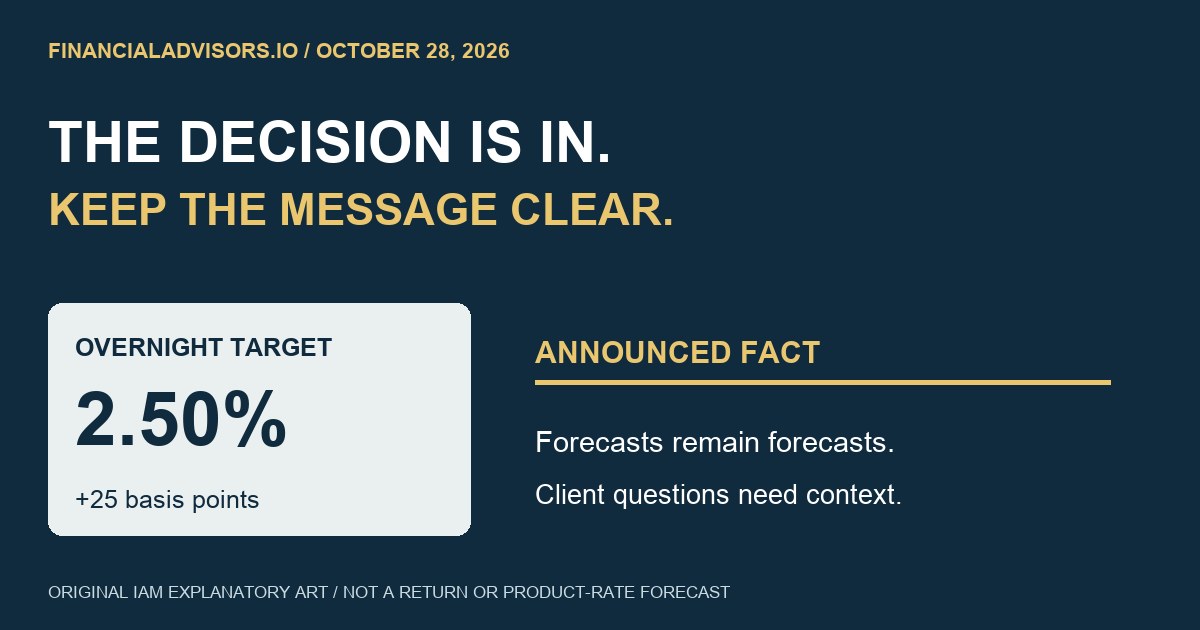
On October 28, 2026, the Bank of Canada raised its target for the overnight rate by 25 basis points to 2.5%. It set the Bank Rate at 2.75% and the deposit rate at 2.45%. A 25-basis-point change is 0.25 percentage point. These are central-bank policy rates, not a quoted mortgage, savings-account or investment return.
The Bank’s release identifies December 9, 2026 as the next scheduled policy-rate announcement. That calendar date does not establish what the next decision will be. This article reports the October 28 decision after publication; it does not revise our October 27 pre-event preparation guide into a prediction that came true.

The outlook is a projection, not an outcome
The October Monetary Policy Report describes a stronger growth outlook alongside more persistent inflation and elevated uncertainty. It projects inflation above 3% through much of 2027 and identifies energy prices and Canada–US trade relations as key risks. Those are the Bank’s dated projections and risk assessments, not established future results.
The Governor’s opening statement explains the policy discussion and emphasizes uncertainty about the economic outlook. Readers who want the Bank’s reasoning should be able to reach those original sources directly rather than relying on a practice newsletter’s shortened version.
IAM analysis: give the first paragraph one job
A financial practice’s first paragraph can report the decision plainly: what changed, when it changed and where the reader can check it. Keep that factual opening separate from the practice’s interpretation. The distinction helps a reviewer notice when a confident sentence has moved beyond what the source actually says.
A useful message does not have to explain every economic development in one screen. Select the part relevant to the audience and link to the full release. If the business serves more than one jurisdiction, make the Canadian context visible. Do not let a general publication appear to describe a specific reader’s agreement or financial position.

Use conditional language where the source is conditional
An outlook paragraph should tell the reader whose expectation is being described and which period it concerns. Preserve uncertainty instead of changing “projects” into “will.” A dated forecast may be revised when conditions or assumptions change; a client message needs to make room for that possibility.
This is a communications choice, not a recommendation to take a particular financial action. A practice can explain that the outlook contains risks without telling every reader to borrow, save, buy or sell. Where a discussion becomes personal or product-specific, it needs the appropriate professional review and current information.
Avoid translating the policy move into a universal promise
A headline about the overnight target should not become a statement that every customer’s next payment changes by the same amount. If a business wants to discuss a particular product, its actual terms and provider information need separate verification. A general article cannot establish the effect on an individual agreement.
The same care belongs in a call to action. Invite a question or an appropriate review without manufacturing urgency or promising a better outcome. Do not use a policy announcement as proof of a particular portfolio return, borrowing decision or market move. This article evaluates none of those outcomes.

Make the review record as clear as the public message
Our proposed publishing record is small: the source URLs, the date checked, the numbers used, the person who reviewed the wording and the version released. Check that the unit “basis points” has not become “percent,” and that a forecast period has not been lost while shortening a sentence.
Preview the actual page and contact route on a phone. If a clarification is needed after publication, explain the change and date it. Keep the earlier pre-event guide’s date and purpose intact. That preserves the difference between preparing a communication before an announcement and reporting what the Bank actually announced.
A practical next conversation for the business
Choose one client-facing page or newsletter draft and separate its statements into announced fact, attributed outlook and practice commentary. Remove any claim that the source cannot support. Then confirm that the reader’s next step matches what the business is qualified and prepared to offer.
These are original IAM communications suggestions, not personalised investment, mortgage, tax or other financial advice. FinancialAdvisors.io does not establish an advisory relationship through this article, and IAM is not represented as holding financial-advice credentials. For publishing and marketing enquiries, use the platform contact below; personal financial questions belong with an appropriately qualified professional.
Sources and editorial scope
Bank of Canada — October 28 policy-rate decision, checked 2026-10-28.
This is IAM business-communication commentary, not personalised financial advice or a regulatory compliance checklist. IAM is not presented as a licensed financial advisor.